

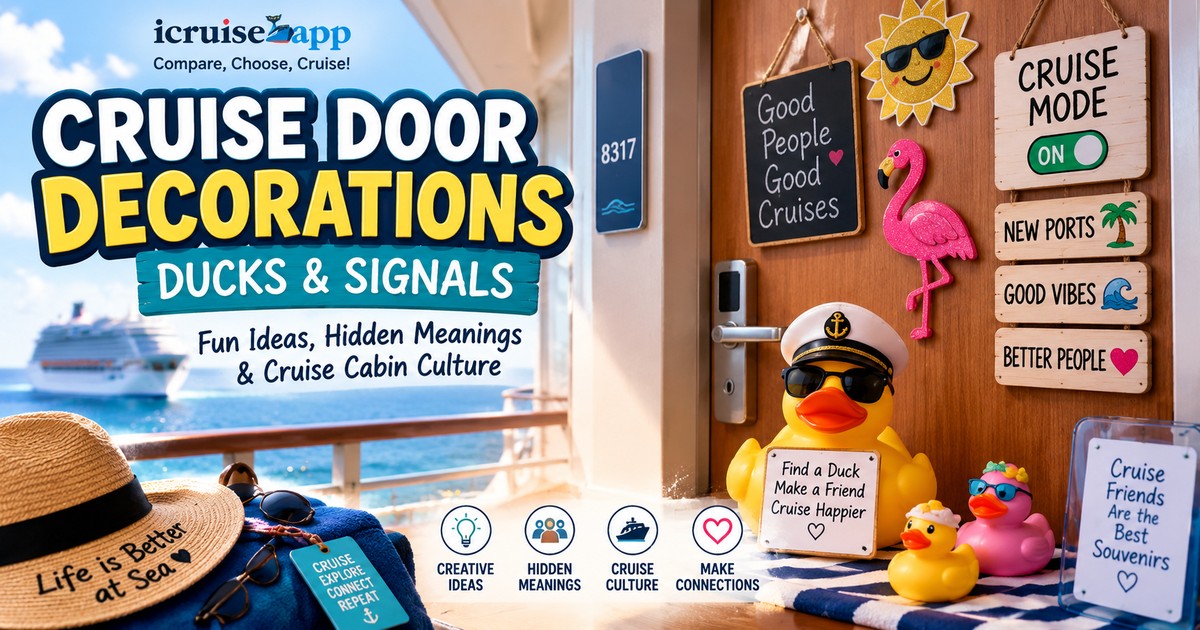
Start with the rule that saves you money and embarrassment: whatever you put on your stateroom door has to be magnetic, removable and out of the doorframe. No tape, no adhesive hooks, no command strips, nothing hanging into the corridor and nothing that could feed a fire. Stateroom doors are fire doors, and hallway clutter is a life-safety issue, not a decorating preference. Crew will take down anything that crosses that line, and adhesive residue can earn you a damage charge.
That is the practical half. The other half is cultural: cruise ships have developed a whole set of small, unofficial signals — hidden rubber ducks, gift bags dangling outside cabins, trading pins, magnet designs that mean something to the people who recognize them. If you have already worked through what the upside-down pineapple is supposed to signal, this is the rest of the vocabulary, and which parts of it are real.
Cruising Ducks: the friendliest scavenger hunt at sea
If you find a small rubber duck tucked behind a deck chair, wedged into a stair railing, or sitting on a bar ledge, you have been ducked. The duck is usually wearing a sticker or a tag with the finder’s instructions: keep it, or re-hide it, and post a photo in whatever Facebook group the tag names.
The tradition is widely credited to a young cruiser and her family who started hiding ducks on a Carnival sailing in 2018, and it spread through social media fast enough that you will now find ducks on most mainstream lines, including Royal Caribbean, Norwegian and Princess. Some lines are enthusiastic about it, some are neutral, and a few crew members would prefer you not hide anything in a place that requires a ladder or a wet deck to retrieve.
How to participate without becoming a problem:
- Hide ducks in dry, public, reachable places. Not in casino slot trays, not on a stage set, not in a crew work area, not in a hot tub.
- Do not hide anything on someone else’s balcony or in a stateroom you are not sleeping in.
- Bring more ducks than you think you need. Kids find them within minutes and the fun runs out by day three otherwise.
- Take your ducks home at the end. Anything left behind is the crew’s problem, not a tradition.
Nobody has to opt in. If you find a duck and simply do not care, put it back where you found it. That is a normal response and no one is offended.
Door magnets: why magnetic, and why some doors refuse
Door decorating grew out of two things — group cruises wanting to find each other in a 900-foot corridor, and the fact that most stateroom doors are steel. Magnets stick, come off cleanly, and do not violate anything.
Two things trip people up. First, not every door is magnetic. Some newer ships and some cabin categories use doors that magnets slide right off, and that varies by ship and even by deck, so testing with a fridge magnet on embarkation day is smarter than arriving with twelve pounds of custom vinyl. Second, several lines have tightened their policies over the years, and the direction of travel is toward less, not more. Fire-safety rules governed by SOLAS conventions are the reason, and no cabin steward has the authority to make an exception.
| What people bring | How it usually goes |
|---|---|
| Flat magnets, name magnets, small magnetic frames | Generally accepted on lines that permit decorating at all |
| Tape, sticky hooks, adhesive banners | Not permitted; potential damage charge |
| Anything with lights, batteries or open flame | Refused; battery lights are sometimes tolerated inside the cabin only |
| Wreaths, garlands or bags projecting into the corridor | Removed if they obstruct the hallway or the door’s seal |
| Full-door wraps and oversized displays | Increasingly restricted, especially on ships with narrow corridors |
Because the policy genuinely differs by line and changes without fanfare, check the current stateroom decoration language in your line’s FAQ or your booking confirmation before you order anything custom. If you are comparing operators before you book, our cruise line directory is a reasonable place to start narrowing down which lines you want to read the fine print on.
Fish extenders, and why the bag outside a Disney cabin is not trash
Disney Cruise Line staterooms have a decorative hook outside the door — most people call it the fish, and it holds the day’s Navigator and any paperwork. Guests started hanging fabric organizers from that hook so other passengers could drop off small gifts, and “fish extender” became a full subculture with sign-up threads, themes and homemade goods.
If you see a row of pockets hanging outside a stateroom on a Disney ship, that family has signed up for a gift exchange with a specific group. It is not an invitation to help yourself, and it is not an open call for gifts from strangers, though a small unexpected token is rarely unwelcome. Similar exchanges have migrated to other lines under other names, usually organized in the ship’s roll-call group months ahead of sailing.
Pin trading works the same way — visible, opt-in, and driven by community rather than the cruise line. Disney runs formal pin events onboard; on other lines, pin and magnet swapping happens informally among people who found each other online first.
The signals that are actually official
Some of what you see in the corridors is not culture at all. It is the ship telling you or the crew something.
- Door hangers. “Make up my room” and “do not disturb” are the only door signals your steward is required to act on. On newer ships this is a switch by the door rather than a card, and it also lights an indicator in the hallway.
- Wristbands. Colored bands most often indicate a beverage package, a spa or thermal-suite pass, a kids’ club check-out authorization, or a shore-excursion group. Colors mean different things on different ships. If someone hands you one, ask what it entitles you to.
- Your muster station code. Printed on your key card, and worth memorizing rather than looking up during an actual drill.
- Dietary and medical cards. Some lines use table cards or notations on your reservation to flag allergies to the galley. That system only works if you notify the line in advance, and it is the one “signal” worth being fussy about.
- Chalk marks and slips on a cabin door. Occasionally maintenance or housekeeping tags. Leave them alone.
What door magnets are genuinely useful for
Stripped of the folklore, a magnet on your door solves a real problem. Long identical corridors, identical doors, and a room number you will misremember at least once. A distinctive magnet means kids can find your cabin, and it means your traveling companions can too without texting from the elevator lobby.
That is why decorating is heaviest on group sailings and family reunions. If you are coordinating twenty people, matching magnets on every door of a block turns a hallway into a landmark — and the same instinct helps with everything else about group logistics, which we go into in our guide to planning a group cruise without losing your mind. Just size it to the door, keep it magnetic, and appoint one person to collect it all on the last night.
Reading other people’s signals without getting it wrong
The honest summary of onboard symbolism is that most of it means whatever the person displaying it thinks it means. A magnet can be a family joke, a hobby group, a sports team, a memorial, or a design someone bought on Etsy because it was cute. Ducks mean someone wants to play. Fish extenders mean someone joined a gift exchange. Anything more specific than that is an assumption, and assumptions about strangers’ cabins are how good vacations get awkward.
Three rules cover almost every case. Do not knock on a door you were not invited to. Do not photograph someone’s cabin door and post it with a caption explaining what they meant. And if a symbol matters enough to you that you would want it recognized, be prepared for the fact that most passengers walking past have no idea what they are looking at.
None of this affects whether you have a good week at sea. But knowing that the duck is a game, the bag is a gift exchange, the wristband is a drink package, and the tape is going to get you charged — that is the working knowledge that makes the ship feel less like a code you have not been given.
