

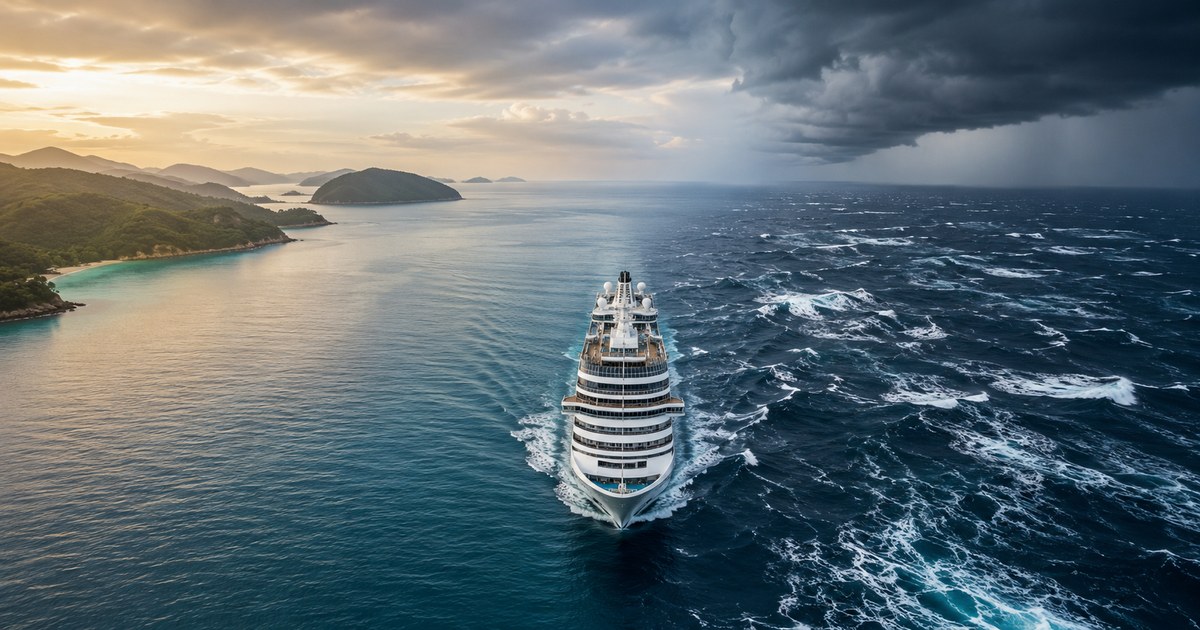
A midship cabin on a low deck helps. Picking water that doesn’t move helps more. If you are prone to motion sickness, the single biggest decision you make is not deck four versus deck eleven — it is whether your ship spends its nights in the open Atlantic or tucked behind a chain of islands, and whether you sail in February or June.
Here is how to read a route before you book it, which stretches of ocean have a reputation for a reason, and what to do when the forecast turns anyway.
Protected water beats open water, every time
Waves need distance to build. Sailors call that distance fetch — the uninterrupted stretch of water the wind blows across. A ship threading between islands, or hugging a coast with land upwind, sits in water that never had room to organize itself into long swells. The same ship 300 miles offshore is in a different world.
That is why Alaska’s Inside Passage feels like a lake and a Gulf of Alaska crossing does not, why the Baltic in July is placid and the Bay of Biscay in November is not, and why two seven-night Caribbean itineraries out of the same port can produce completely different weeks. Look at the itinerary map. If you can trace a line that stays inside islands or within sight of a coastline, you have found the calmer product.
Stretches of water with a reputation
None of these is off-limits. Plenty of people cross the Drake Passage and love the trip. But you should know what you are buying.
| Water | Why it moves | Typically worst |
|---|---|---|
| Drake Passage (South America to Antarctica) | No landmass to interrupt the Southern Ocean; two days of exposed crossing each way | Any time; late season can be worse |
| Bay of Biscay (Spain/France, on UK–Mediterranean routes) | Atlantic swell meets a shallowing shelf | Autumn and winter |
| North Atlantic crossings | Six days of open ocean with nothing to hide behind | Late autumn through early spring |
| Gulf of Alaska (one-way Vancouver/Seattle to Seward or Whittier) | An open-ocean leg outside the island chain | Shoulder weeks in May and September |
| Tasman Sea (Australia to New Zealand) | Southern Ocean weather systems funneling through | Southern-hemisphere winter and shoulder |
| West Coast to Hawaii | Four to five consecutive days of open Pacific | Winter storm season |
| Western Mediterranean, Gulf of Lion | Mistral winds accelerating down the Rhône valley | Late autumn through spring |
| Cape Horn and Chilean coast rounding | Same Southern Ocean exposure as the Drake | Outside the summer season |
Add one more that surprises people: the Caribbean around the Christmas and New Year holidays. Strong trade winds and north swell pushing down from Atlantic systems can make late December and January noticeably livelier than the glossy brochure suggests, particularly on eastern itineraries that spend nights in open water between islands.
Where the water is usually quiet
The calmest mainstream cruising is close to shore, in summer, on a route with short overnight hops.
- Round-trip Alaska from Vancouver or Seattle. Almost the entire route sits inside the island chain. There is one genuinely exposed stretch across Queen Charlotte Sound, usually crossed at night. If motion is your concern, the round-trip is the version to book — you can see how the round-trip and one-way options differ when you browse Alaska sailings and their routings.
- Norwegian fjords and the Baltic in summer. Sheltered water, long daylight, short sailing distances.
- Eastern Mediterranean and Greek islands, late spring through early autumn. Port-intensive itineraries with brief overnight runs. The Aegean meltemi wind can kick up in July and August, but it rarely builds ocean swell.
- Southern Caribbean loops from Barbados, Aruba or San Juan. Farther south, generally out of the winter north swell, with shorter distances between islands.
- Panama Canal and Central American coastal routes, which spend most of their time in sheltered or lee-side water.
- River cruising. If seasickness has ruined a trip for you before, a Danube, Rhine or Douro sailing removes the variable entirely. The boat does not roll. This is the honest answer for the small number of people whom nothing else helps.
Season changes the answer more than the destination does
The same route can be a different trip six weeks apart. Two seasonal patterns matter most to North American cruisers.
Atlantic hurricane season officially runs June 1 through November 30, with the statistical peak in late August and September. Most storm weeks pass without incident, and lines reroute aggressively to stay clear — we’ve written separately about what actually happens to your cruise when a hurricane forms. What matters for motion sickness is that a distant storm you never see can send swell hundreds of miles, so a diverted, sunny sailing can still be a rolling one.
Winter North Atlantic weather drives everything from transatlantic crossings to Biscay to the Christmas-week Caribbean swell. Spring and autumn repositioning cruises are wonderful value and often lovely, but they exist precisely because ships are crossing large empty stretches of ocean. Go in with your eyes open.
What stabilizers actually fix
Modern stabilizers are retractable fins that extend from the hull below the waterline and counteract roll — the side-to-side motion. They do that job well, and on a large ship in moderate seas you may barely register it.
What they do not fix is pitch, the fore-and-aft seesaw when a ship meets swell head-on, or heave, the elevator sensation as the whole hull rises and falls. Head seas produce exactly the motion stabilizers cannot cancel, which is why a rough night is often described as bouncing rather than rocking.
Bigger and newer generally helps: greater displacement, more mass, more modern hull design. But size is not a force field, and one more variable trumps it — where the ship is going. A 180,000-ton ship in the Gulf of Alaska in September will move more than a 90,000-ton ship in the Inside Passage in July. If you are weighing two vessels, it is worth putting their tonnage and build year side by side when you compare ships, then checking the itinerary each one is running.
Read the itinerary like a navigator
Three things to look for on the day-by-day grid:
- Count the consecutive sea days. One sea day mid-cruise is fine. Four in a row means open ocean with no chance to reset on land.
- Look at the departure and arrival times. A ship leaving at 5 p.m. and docking at 8 a.m. the next morning is making a short hop. A ship leaving at noon and arriving at 2 p.m. the following day is covering serious distance.
- Find the exposed legs. Every itinerary has one or two stretches where the ship leaves shelter. Know which nights those are and plan around them — that is the night to take the medication before dinner, not after you feel it.
Check the water before you sail
A week out, forecast tools give you a real preview. Look at significant wave height rather than wind speed, and note the swell period: eight-foot seas with a long 12-second period feel like a gentle lift, while six-foot seas with a short five-second period are choppy and unpleasant. Marine forecasts from the U.S. National Weather Service and Ocean Prediction Center cover most Atlantic and Pacific cruising areas, and consumer apps such as Windy display wave and swell layers on a map. None of it is a guarantee, and your captain has better data than you do, but it will tell you whether to load up on remedies.
If it turns anyway
Get low and central — the same logic as your cabin applies to public spaces. The atrium and midship lounges move least; the forward theater and the aft dining room move most. Go outside where you can see the horizon; the mismatch between what your inner ear feels and what your eyes see is the whole problem, and a real horizon resolves it faster than anything.
On remedies, talk to a pharmacist or your doctor before you sail rather than sorting it out at sea. Over-the-counter antihistamines and prescription patches are both commonly used, most work far better taken before symptoms start, and some cause drowsiness that matters if you are driving to the port or planning an active excursion. Ships’ medical centers can help if you are genuinely unwell, though visits are billed and prices vary by line. Bring what you plan to use; the onboard shop’s supply is limited and expensive, and it runs out on exactly the days you need it.
The practical summary: sheltered route, summer month, midship cabin, medication taken early. Get the first two right and the last two rarely have much work to do.
